Technology
Precise wettability control for films and membranes, from superhydrophilic filtration surfaces to highly hydrophobic barrier coatings, solvent-free, and fully compatible with flexible substrates at industrial scale.
What we solve
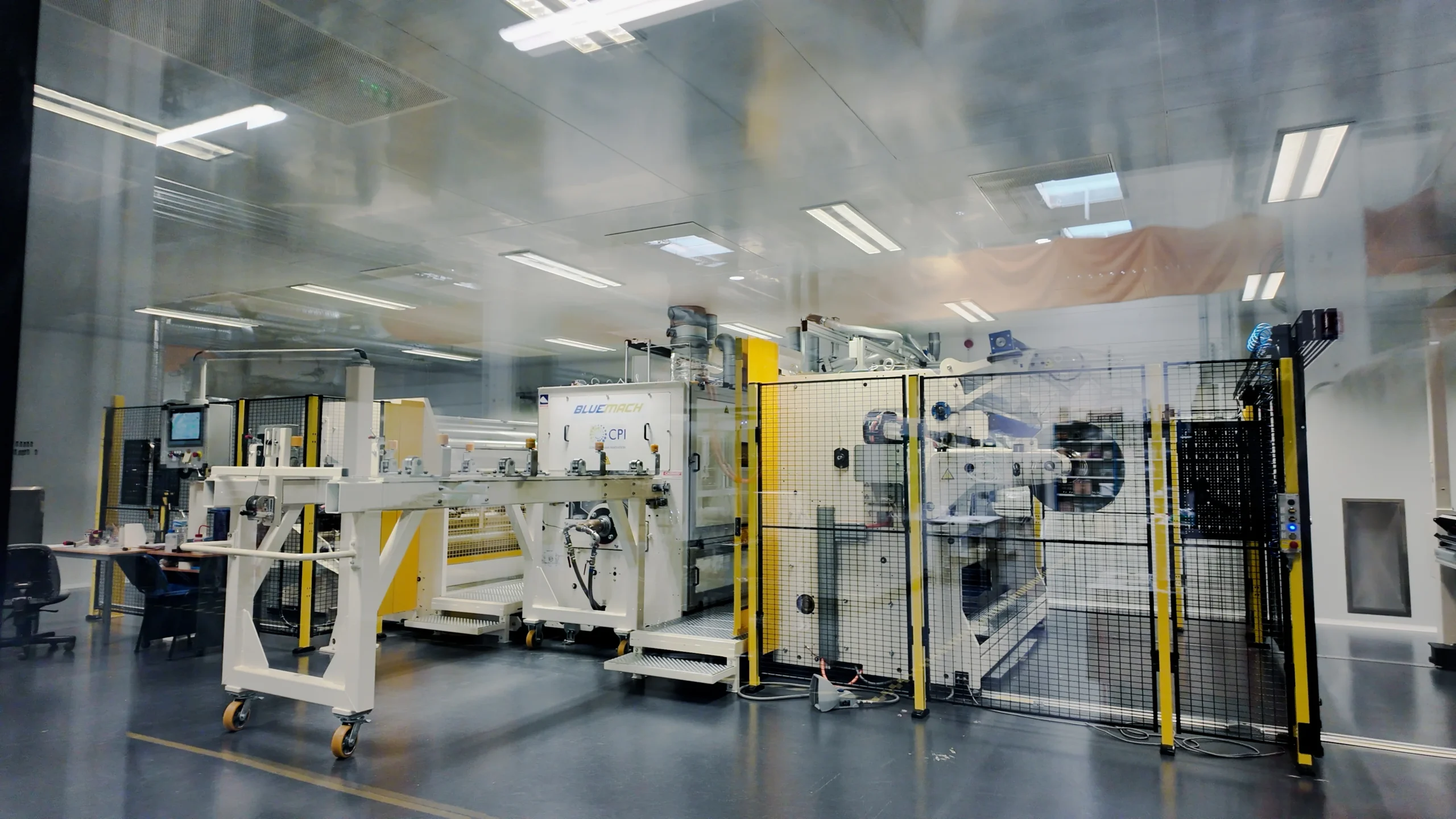
Bluemach is CPI’s proprietary atmospheric plasma PECVD (Plasma-Enhanced Chemical Vapour Deposition) platform. It is the only industrial-scale system of its kind capable of depositing sub-30 nm functional nanocoatings in a continuous roll-to-roll process without vacuum.
Bluemach is CPI’s proprietary atmospheric plasma PECVD platform. It enables industrial-scale, continuous roll-to-roll deposition of ultra-thin functional nanocoatings from 1 nm up to 30 nm. Where 30 nm is often the lower limit for conventional technologies, Bluemach can go significantly thinner, without vacuum.
Web Width
Up to 2000 mm
Processing speed
10 – 500 m/min
Coating thickness
< 30 nm
Environment
Class 1000 cleanroom
Operating pressure
Atmospheric — no vacuum
Substrate temperature
Ambient — no heating
The real challenge
Corona oxidises your substrate. We don’t. By controlling gas composition, we graft specific functional
groups without polymer degradation.
Deposit ultra-thin functional layers (10–50nm) in a single pass. PFAS-free release coatings and barrier films at industrial speed.
Attach specific functional groups (NH₂, COOH, OH, …) without breaking the polymer backbone. Stable adhesion on PEEK, fluoropolymers, elastomers.
Process at line speed without vacuum chambers. Scalable from lab to 500m/min production with zero environmental impact.
How it works
Standard PECVD
Plasma-Enhanced Chemical Vapour Deposition (PECVD) is a well-established technology for depositing thin films. Conventional PECVD requires a vacuum chamber, high temperatures, and batch processing — all of which are incompatible with flexible film substrates and roll-to-roll production.
CPI’s AP-PECVD
CPI’s atmospheric pressure variant (AP-PECVD) eliminates the vacuum requirement entirely. A dielectric barrier discharge (DBD) generates cold plasma at atmospheric pressure. Precursor chemistry is introduced in the gas phase and reacts with the substrate surface to deposit a functional nanocoating — all in a single inline pass.
Operates at atmospheric pressure. No vacuum chamber, no batch cycles, no throughput limitation.
Cold plasma process at ambient temperature. No thermal damage to heat-sensitive substrates.
Entirely dry gas-phase chemistry. Zero solvent waste, zero VOC emissions, zero PFAS.
Integrates into existing roll-to-roll lines. Processing speeds from 10 to 500 m/min.
Technology comparison
Corona treatment has been the industry default for surface activation for decades. Atmospheric plasma fundamentally changes the outcome, with measured data to prove it.
Tell us your surface treatment challenge and we’ll evaluate whether our technology can solve it.
To provide the best possible experience, we use technologies such as cookies to store and/or access information about your device. By consenting to these technologies, you allow us to process data such as browsing behavior or unique identifiers on this site. If you do not give your consent or withdraw your consent, this may adversely affect certain features and capabilities.